
How Traffic Warrants Work in Anne Arundel County
Every Anne Arundel County traffic warrant traces back to a citation that went off track. The officer's ticket is a charging document filed with the District Court, and the court prints a response deadline right on it. Miss that deadline and the case can turn into a failure-to-appear event, which is where a warrant becomes possible once the court authorizes one. The mechanics matter here. A driver who simply fails to pay or comply inside the response window faces a different consequence: the Motor Vehicle Administration can suspend the license. Skipping a required court date is a court problem instead. A must-appear citation says so on its face, warning that a failure to appear may result in an arrest warrant. So the citation itself tells you which risk you are carrying, and the court record shows whether the worst of it has already happened.
Note: An unpaid balance alone does not prove a warrant exists, and only the court record shows what actually happened in the case.
Case Search Is the Traffic Lookup Route
Maryland Judiciary Case Search is the lookup tool for a traffic citation, and it rewards a narrow search over a broad one. Accept the agreement screen, then land on the search criteria. A citation or case number is the fastest identifier. A name search works as the fallback. Two dropdowns do real work on that page: pick the traffic case type, and restrict the court system to District Court, which keeps the results inside the right family of cases for an Anne Arundel County ticket. Open the case number from the result list and the summary appears with its docket events attached. Read it slowly. The summary can show a citation number, a fine amount, a violation date, and the county, and those fields move as staff enter new events. Treat it as a pointer, not proof. A summary is not an official court document, so anything a real decision depends on goes back to the clerk.
Anne Arundel County Traffic Warrant Checks
Five channels can answer a traffic question in Anne Arundel County, and each one answers something different. Work outward from the citation itself instead of jumping straight to the sheriff's list.
- Search Case Search by citation or case number, with the traffic case type and District Court selected.
- Call the District Court location named on the citation, Annapolis at (410) 260-1370 or Glen Burnie at (410) 260-1800.
- Ask the court whether a warrant, a license hold, or a new date is the current status of that case.
- Call the sheriff's warrant line at (410) 222-1570 to confirm whether process is executable.
- File a Maryland Public Information Act request only if you need a specific historical or agency-held record.
For a recent traffic matter, the sheriff's published list is the weakest channel in Anne Arundel County. It covers only older unserved county warrants. A fresh failure-to-appear event shows up in the court record first.
The Four Responses to a Payable Citation
A payable citation opens a set response window, and the Maryland Judiciary traffic guidance lays out four choices. Each one leads somewhere different. Picking one closes off the others, so Anne Arundel County drivers should read all four before acting.
| Response | What It Means | Watch For |
|---|---|---|
| Pay in full | Pleads guilty and closes the citation by payment | Do not pay if you intend to contest the citation |
| Payment plan | Installs the amount owed over time where the driver qualifies | Eligibility rules apply and approval is not automatic |
| Waiver hearing | Offers an explanation to the court without a trial | Request it before paying, not after |
| Trial | Contests the citation at a hearing | Missing that date is what creates the FTA exposure |
A court date is not the same obligation as payment. A driver in Anne Arundel County who pays the fine but skips a required appearance has still missed the appearance. That is the exact event the must-appear notice warns about.
Traffic Warrants: What They Show
A traffic record in Anne Arundel County carries two numbers doing different jobs. The citation number identifies the ticket the officer handed you. The case number identifies the court file built from that ticket.
| Citation Number | The identifier on the officer's copy, shown in CITATION-000000 style text. |
|---|---|
| Case Number | The District Court docket identifier used in Case Search and with the clerk. |
| Violation Data | The violation date, the charge, the county, and the fine amount where the court records one. |
| Case Status | The current posture of the case, which may change as staff enter hearing and payment events. |
| Docket Events | Hearings, failures to appear, and other entries that explain how the case reached its current state. |
What the record does not carry is personal history. A court file in Anne Arundel County describes one case, not a driver's habits behind the wheel. For anything about your driving record itself, the court file is the wrong document to consult.
What the Must-Appear Notice Warns
How much risk a missed date carries depends on the kind of citation in hand. A must-appear notice orders the driver to a specific court on a specific date, and the official notice-to-appear form states plainly that failing to appear may result in an arrest warrant. These are the matters serious enough that the court wants the driver in front of a judge. Read the citation before assuming anything. The ticket itself is the authority on which category applies, and checking it first prevents a wrong guess in either direction. One more point keeps expectations honest: a warrant does not follow automatically from every unpaid ticket in Anne Arundel County. The case-specific status in the court record controls what happens next.
Clearing an Anne Arundel County Traffic Warrant
Clearing a traffic warrant in Anne Arundel County runs through the court that issued it. Why the warrant exists sets the route. A missed appearance is a scheduling problem. An unpaid balance is a payment or compliance problem.
Caution: Do not pay a citation before deciding whether you want a waiver hearing or a trial, because payment ends the case as a guilty plea and cannot be undone.
After a single failure to appear in a traffic matter, the Judiciary's traffic guidance points drivers to a written request for a new trial or hearing date, directed to the original court. It is a request, not an entitlement, and the court decides. For an Anne Arundel County warrant already issued, the same courthouse is where the recall or satisfaction question belongs. The sheriff's warrant line answers separately whether the process is still executable.
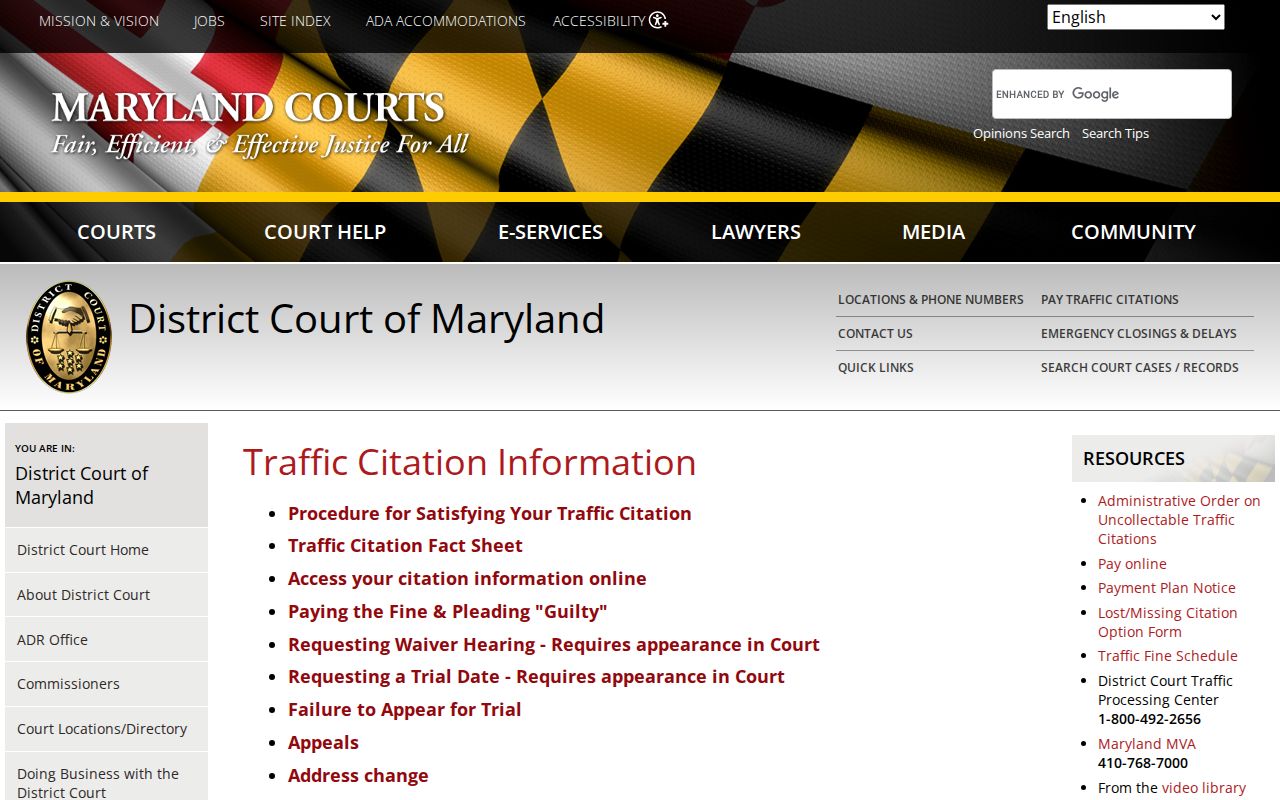
The Judiciary traffic page sets out the response choices and the consequences of a missed date. Find it at mdcourts.gov/district/selfhelp/traffic, the current version for Anne Arundel County drivers.
Traffic Processing Center: Mail and Phone Routes
Traffic cases in Anne Arundel County do not all get settled at the courthouse counter. Maryland's traffic page lays out several ways to pay: online, at a court cashier, by mail, through an automated phone line, or at Motor Vehicle Administration kiosks. Some carry a service charge. Mail goes to the District Court Traffic Processing Center, P.O. Box 6676, Annapolis, MD 21401. The center's direct number is (410) 260-1093, and the statewide payment line is (800) 492-2656. Keep the receipt. Keep the citation number with it. A receipt proves the transaction only. The docket can take time to catch up with the payment. Neither one recalls a warrant on its own.
How Traffic Warrants Trigger License Holds
The court case and the license run on separate tracks. They move at different speeds, so knowing which track is live tells an Anne Arundel County driver what to fix first.
| Situation | Court Consequence | License Consequence |
|---|---|---|
| No response within the payment window | Case continues; compliance issues can escalate | The Motor Vehicle Administration may suspend the license |
| Missed trial date | Failure to appear; a warrant may issue on a must-appear case | A suspension may follow the failure to appear |
| Driving while suspended | A separate charge, which can carry incarceration | The suspension continues until compliance is documented |
A license hold is not a warrant. A warrant is not a suspension. One case can produce both, and in Anne Arundel County, driving on a suspended license turns a paperwork problem into a criminal charge.
What to Do After a Traffic FTA
Order matters more than speed here. Read the citation first. It names the court and says whether the matter is payable or must-appear. Then check the case record. If the online summary leaves the warrant question unclear, call the District Court location named on the citation and ask for the current status and your options. Annapolis answers at (410) 260-1370. Glen Burnie answers at (410) 260-1800. The Anne Arundel County clerk can explain the filing steps, though the clerk cannot give legal advice. If a warrant has issued, the warrant check page explains how to verify it with the Sheriff's Office and what a surrender or recall involves. One thing to avoid in any traffic file is paying a stranger who calls about a warrant. Maryland courts do not demand payment by text message. Fake warrant and toll threats circulate widely. The Judiciary has issued a public warning about them, so hang up and call the court back at a listed number.