
How Municipal Court Warrants Work
In states that have a city court tier, a municipal warrant comes from a city judge for an ordinance, traffic, or failure-to-appear case, and a city marshal or police department serves it. People arriving from those states expect the same setup in Anne Arundel County and come up empty, because Maryland simply does not work that way. The state's courts run on four levels: the Supreme Court of Maryland, the Appellate Court of Maryland, the Circuit Courts, and the District Court. There is no municipal court among them, and no justice-of-the-peace court either. Local ordinance and city citation matters get heard in the District Court, where a judge or a District Court commissioner may issue the process. What a city still supplies is policing. Annapolis runs its own department, while other communities depend on the Anne Arundel County Police Department or the Sheriff's Office. Those agencies make arrests and serve court orders. None of them runs a court.
Maryland Has No Municipal Court Layer
The missing tier sets a practical trap. Someone who assumes a city court holds their case may wait for a notice that never comes, or call an office with no record of it and decide the matter vanished. A city street address on a citation changes nothing. The citation is filed in the District Court of Maryland, and the location printed on it is simply the courthouse where the case will be heard, which makes the citation, not any city name, the document that tells you where to go. For the structure itself, the state's own description of its court system at mdcourts.gov/courts/about lists the four levels and shows no municipal court anywhere in Maryland.
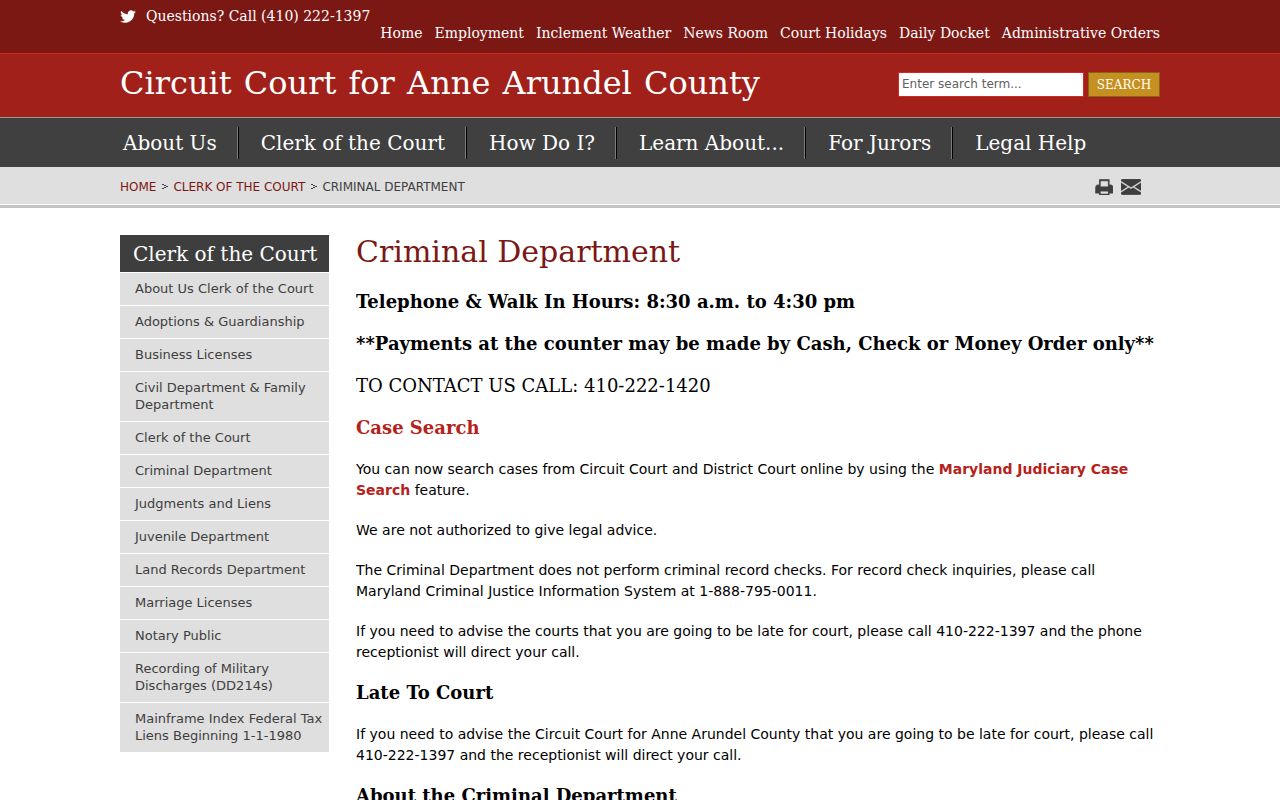
For serious charges, the comparable office is the Anne Arundel County Circuit Court criminal department. Its page at circuitcourt.org/clerk-circuit-court/criminal-department describes counter hours and the process it issues, including warrants and body attachments.
Municipal Courts Across Anne Arundel County
Two incorporated municipalities exist in Anne Arundel County, and neither runs a criminal or traffic court. Honest routing guide, then, not a court list.
| Place | Police Agency | Court That Hears Its Cases | Contact |
|---|---|---|---|
| Annapolis | Annapolis Police Department | District Court at Annapolis or Circuit Court at 8 Church Circle | District Court (410) 260-1370; Circuit Clerk (410) 222-1397 |
| Highland Beach | Anne Arundel County Police Department | District Court at Annapolis or Glen Burnie, or Circuit Court | County Police (410) 222-8050; District Court (410) 260-1800 |
| Unincorporated communities | Anne Arundel County Police Department districts | The same District and Circuit Court system | County Police (410) 222-8050 |
Anne Arundel County police districts cover Brooklyn, Pasadena, Odenton, and Edgewater, with headquarters and Central Records in Millersville. A district station can take a report and make an arrest. It holds no court records. It cannot tell a caller whether a judge recalled a warrant.
Annapolis Police Does Not Mean Annapolis Municipal Court
The city police department and the courts sharing its geography are separate institutions with separate records. Annapolis Police Department operates from 199 Taylor Avenue, and its Central Records office handles police report requests, not court files. Anything court-related for a case that began in the city sits in the state system. A traffic citation goes to the District Court; a serious criminal charge goes to the Circuit Court. The case number tells you which clerk holds the file, and the city logo on a police report has no bearing on either. The gap matters most on a warrant question, since the department that investigated is not always the agency that serves the process. In Anne Arundel County the Sheriff's Office is the primary service agency for court orders of arrest, and the sheriff's warrant line is the number that confirms status.
Anne Arundel County Municipal Warrant Checks
No city court means no city phone call. A warrant check in Anne Arundel County runs through county and state channels instead. Five steps cover the ground.
- Read the citation or charging document to identify the court named on it.
- Search Case Search by case or citation number for the case summary and docket events.
- Call the District Court location that holds the case, Annapolis at (410) 260-1370 or Glen Burnie at (410) 260-1800.
- Call the Circuit Clerk at (410) 222-1397 for serious criminal, family, or juvenile matters.
- Call the sheriff's warrant line at (410) 222-1570 to confirm whether process is executable.
One caution runs through the whole list. An Anne Arundel County city police department can answer questions about its own reports. It cannot answer a warrant status question that belongs to the court or the sheriff.
Highland Beach: County Police, No Town Court
Highland Beach is an incorporated Maryland town, and its small scale shapes how its services look. The town's official emergency-preparedness page states that the Anne Arundel County Police Department handles law enforcement there, and no town police department or municipal court exists alongside it. What the town does list is contact information and resources that route residents to county police and the Circuit Court. So a resident with a warrant question uses the same channels as anyone else in Anne Arundel County: the sheriff for status, the issuing court for everything else. Incorporation gives a town a government, not a criminal court. Nothing about the town's size builds a separate home for criminal records.
Municipal Warrants: What They Show
What a reader might call a city warrant record is really a District or Circuit Court file. The fields inside match any other warrant in Maryland. Anne Arundel County adds nothing extra to the inventory.
| Case Number | The docket identifier, and the number a clerk can work from. |
|---|---|
| Citation Number | The officer's identifier for a traffic or ordinance matter, shown in CITATION-000000 style text. |
| Process Caption | The label on the paperwork, such as bench warrant or State capias. |
| Issuing Authority | The judge, commissioner, or clerk-on-order who signed it, with the date. |
| Court | The District Court location or the Circuit Court, which decides which clerk to call. |
| Status | Active and unserved, served, recalled, or satisfied, as the court currently records it. |
In Anne Arundel County, bond shows up on the court order itself. Nobody publishes a list of municipal bond amounts, so never infer one from a charge name or from another county's fee schedule.
City Police Records Versus Court Records
Annapolis Police Department Central Records takes report requests online, by mail, and in person at 199 Taylor Avenue, with report copies running five dollars by check or money order. The office numbers its events starting with the date, and its counter hours run shorter than its dispatch hours. None of that touches a court file, though. A police report covers only what an officer saw, while a court record holds what happened in the case: the hearings, any failure to appear, and the process after that. Asking one office for the other gets you nothing. Anne Arundel County works the same way. Police Central Records in Millersville keeps County Police reports, while the Sheriff's Office holds the warrant and service papers. Name the office and the record type in your first sentence, and the request will not bounce between desks.
Clearing a Municipal Court Warrant
This process came from a state court. That means Anne Arundel County resolution runs through the court and the sheriff, never a city window. First ask whether the warrant is still executable; the sheriff's warrant line answers that.
Caution: No city or county office accepts a payment to clear a warrant on the spot, and no one can promise a recall, so treat any caller who offers one for a fee as a scam risk.
Next comes what the court will accept. A District Court matter might mean a new date, a recall request, or a surrender arranged through Safe Surrender, while a Circuit matter runs through the Circuit Clerk and its criminal department. Someone charged under a city ordinance follows the same steps, because Anne Arundel County puts the case in the same court system either way. Then document everything. Ask for the order, receipt, or docket entry showing what changed, and keep the next appearance date.
Why Unincorporated Communities Are Not City Courts
Glen Burnie, Odenton, Pasadena, Brooklyn Park, Edgewater, and Severna Park are familiar names with no city government behind them. They are communities inside Anne Arundel County, so a warrant tied to any of them moves through the same District or Circuit Court as everything else. The confusion makes sense. Glen Burnie even has a courthouse, but that building is a District Court of Maryland location, not a city court, and the same goes for the Annapolis courthouse on Rowe Boulevard. Official population sources list only Annapolis and Highland Beach as incorporated places. The right move is to identify the court from the case number.