
Inside the Anne Arundel County Most Wanted Program
Anne Arundel County runs its wanted information differently from many counties. There is no standing most-wanted wall of faces here. Instead, the Sheriff's Office publishes a single active warrant list, pairs it with a tip channel, and flags certain rows in a first column labeled On The Lookout that ties each published record to a tip action. The sheriff's warrants page explains the unit's work and the document families it handles, which run from arrest warrants and bench warrants to body attachments, fugitive warrants, governor's warrants, grand jury indictments, and juvenile detention orders. A separate legacy lookout program page is referenced in the active list's own script, and the county's tip infrastructure sits beside both. The whole setup leans on tips and verification, not a photo gallery.
410-LOOKOUT Is a Tip Line, Not a Status Check
People mix up two numbers here more than any others. Anne Arundel County runs a warrant line and a tip line, and they do different jobs. Calling the wrong one just wastes a turn.
- 410-LOOKOUT
- The sheriff's tip line, reached at (410) 566-5688, for information about a listed warrant.
- Warrant line
- The Sheriff's Office public contact at (410) 222-1570, used for status verification and Safe Surrender arrangements.
- On The Lookout
- A flag column on the published table that links to a tip action rather than a separate legal category.
- Submit Tip
- A form opened from a selected published record, not a free-form warrant lookup.
Your own record is a question for the Anne Arundel County warrant line. Something you saw about a listed record belongs with the tip line or the online form. Legal advice? Neither number gives it. That is a job for a lawyer.
How Anne Arundel County Most Wanted Lists Work
One list, one scope. The page states its own limits. The database holds unserved Anne Arundel County warrants active six months or longer, updated weekly and accurate only as of the upload date.
Note: The county's notice says the list is informational, covers only older unserved county warrants, and requires verification by a Maryland law enforcement agency.
A curated most-wanted feed would be a smaller cut of that group, published with photos or reward language. Anne Arundel County has no sheriff-run roster of that kind now. Treat the active list and its tip links as the live channels, and recheck the sheriff's page instead of trusting an old announcement.
On The Lookout: A Tip Flag, Not a Legal Status
The first column of the published table carries a label that sounds heavier than it is. On The Lookout is a program pointer, nothing more. It links a row to a tip action, and in the page script it connects that row to a legacy sheriff lookout address. It does not create a second kind of warrant, attach a reward, or mark anyone as dangerous. Every row is already an unserved warrant in a defined age cohort, and the flag only shows which ones the page invites tips about. Reading it right matters, because some readers treat the Anne Arundel County list as a public ranking. The published notice supports no such reading, and that notice is the only county guidance on how the data should be used.
Sending a Most Wanted Tip Safely
A useful tip describes what you observed, not what you concluded. The Anne Arundel County sheriff's form is built exactly for that. It asks for the date and time, a location, and a plain description of what happened.
Key Point: Send information through the sheriff's submit warrant tip form or the tip line at (410) 566-5688, and do not post names or addresses publicly.
The form carries the record's warrant number, name, age, charge, city, and zip code forward, so the fields you add are the time, place, and description.
Contact details stay optional on the form. A name, email, or phone number can identify the tipster, so anyone who needs anonymity leaves those fields blank. A certification checkbox warns that a false report carries consequences. Two safety rules apply to any tip in Anne Arundel County. Never approach a person on the list, and never visit an address from it, because that column is agency data.
County Police Tips and Metro Crime Stoppers
Two separate tip systems operate in Anne Arundel County, and mixing them up sends your tip to the wrong program. The sheriff's channel takes warrant tips on published records. The County Police Department's crime information page routes tips about crimes and cold cases, and it names Metro Crime Stoppers as an independent organization with its own intake.
| Channel | What It Handles | How to Use It |
|---|---|---|
| Sheriff's tip line | Information about a published warrant record | (410) 566-5688 or the online warrant tip form |
| County Police anonymous tips | Crime information and cold cases | County Police anonymous tip line at (410) 222-4700 |
| Metro Crime Stoppers | Independent tip and reward program | Statewide tip number 1-866-7LOCKUP and P3 Tips |
| Annapolis Police tips | City crime information | 410-280-CLUE (2583) |
The County Police crime information page lists the anonymous tip routes and names Metro Crime Stoppers as a separate program.
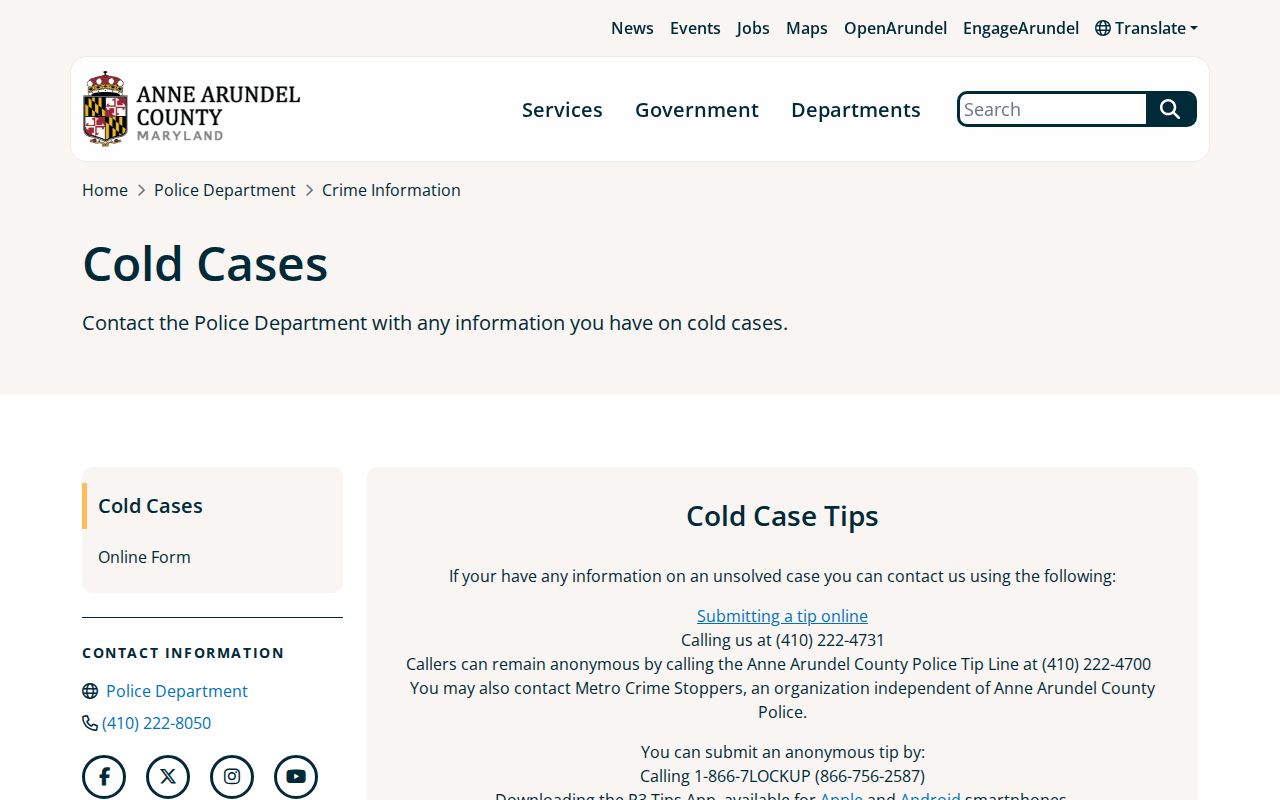
That page lays out how a crime tip reaches a program outside the Anne Arundel County sheriff's warrant tip line.
Rewards in Anne Arundel County Are Case-Specific
Reward money is the most misunderstood piece of a most-wanted program. No standing schedule attaches to the Anne Arundel County warrant list. A reward belongs to one case and one announcement, and the announcing agency decides who qualifies and how a claim gets paid. One dated example shows the pattern. A County Police release from September 26, 2025 described a warrant-led investigation with an anonymous tip route and reward language of up to $2,000, and that figure belonged to that case alone; the same office would have to confirm any current offer. The practical rule holds either way. Send your information through the channel named in the announcement, keep the reference number, and ask that office about eligibility rather than trusting a reposted amount.
How Most Wanted Differs From an Active Warrant
An active Anne Arundel County warrant is process that still waits to be served. A most-wanted page is a hand-picked subset, pulled from a bigger pool of outstanding warrants to grab public attention.
| Question | Active Warrant List | Most Wanted Publication |
|---|---|---|
| Who publishes it | The county sheriff | A sheriff or partner program appeal |
| How large it is | The whole older unserved county cohort | A small selected subset |
| What it contains | A table of record fields | Descriptions and often images |
| What drives it | Service status in the warrant system | Case priority and public appeal |
| What a reader does | Verify status and resolve the process | Send information through an official tip channel |
Anne Arundel County currently publishes the active warrant list with tip links, not a most-wanted roster. Start there, and use the tip form attached to the record you find.
Why This Page Carries No Names or Photographs
Warrant records are public, but republishing them is a different act with different consequences. Circulated photographs and addresses can trail a person for years. Anne Arundel County's table even lists a last-known address. Officers need that column to confirm they have the right person. It also makes the data poor material to share or act on. The address can be years old. The person named may have no tie to it anymore.
The county's tip page draws the same line. Tips go to an official channel that requires certification. The record's own fields travel along from the selected row, so a tipster never has to retype personal details from memory.
When You Believe You Are Listed
Spotting your own name in a public table is a moment to slow down. Call two Anne Arundel County offices before acting on what the page says.
Important: Call a lawyer and the sheriff's warrant line, and do not approach anyone about the listing, because an unserved warrant can be executed at any contact with law enforcement.
Call the warrant line at (410) 222-1570 first. Ask whether the process is still executable. Anne Arundel County's Safe Surrender program can then set up a verified meeting and transfer to the Central Holding and Processing Center, where you appear before a commissioner. Give the clerk your case number and the issuing court's name. Expect the case to keep going after the warrant is handled. Clearing process changes custody and enforcement only. The underlying charge keeps its own docket and its next date.